
Complete Shiba Inu Black and Tan Guide
It’s true that the Shiba Inu is a dog breed originating from Japan, known for its beauty and spirited personality.
Its appearance sometimes resembles that of a plush fox, with a coat that can come in four main colors: red, cream, black and tan, as well as the sesame pattern.
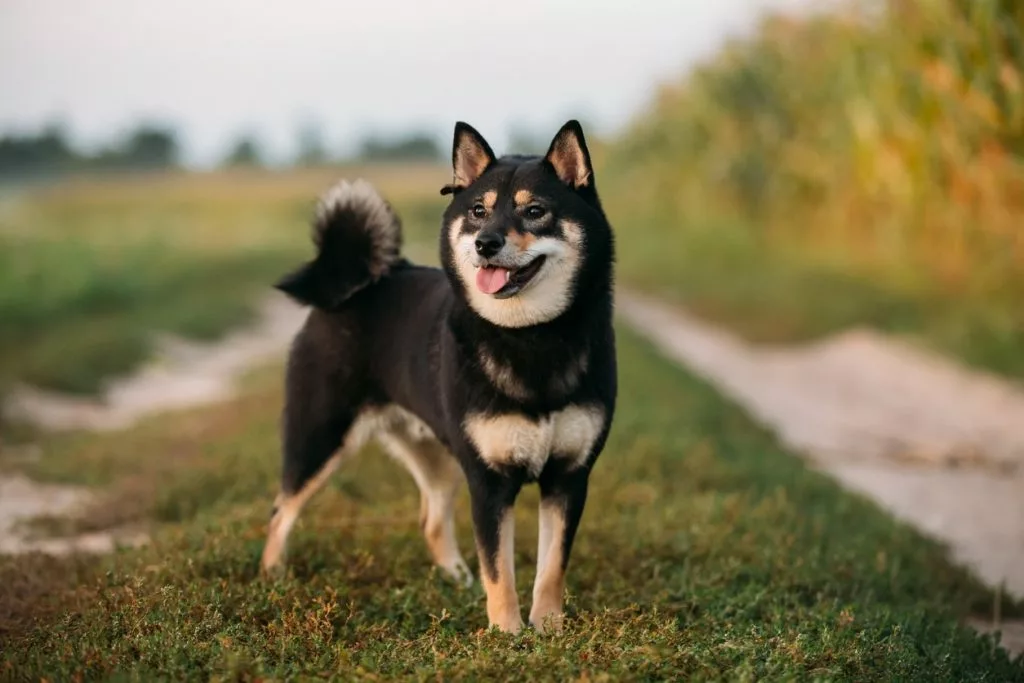
Standards established by organizations like the American Kennel Club (AKC) and the Fédération Cynologique Internationale (FCI) only recognize these four colors as the standard for the Shiba Inu. Therefore, a solid black Shiba Inu is not recognized within the official breed standards.
That being said, it’s possible for some Shibas to have a more pronounced black color in their coat, but it typically doesn’t correspond to a solid black. If you are looking for a Shiba Inu, it’s crucial to approach reputable breeders and ensure that the dog you’re considering for adoption adheres to the breed standards.
What is a black and tan Shiba Inu?
The existence of a completely black Shiba Inu is a nonexistent chimera. Neither the AKC nor the FCI validates a solid black coat, but they instead recognize two color variations: the black and tan Shiba, as well as a sesame pattern called black sesame Shiba.
Both types have a color palette consisting of two or more hues, accompanied by a whitish mark that the Japanese call “Urajiro.”
3 Things to Remember About Black Shiba Inus
The Black Shiba Inu attracts the interest and affection of many people. This breed, originating from Japan, is renowned for its elegant beauty and distinctive character. Here are three key things to remember:
Japanese Breed, Not Chinese
The Shiba Inu is a dog breed originating from Japan. It is one of the country’s oldest and smallest native breeds. The White Shiba Inu is a color variation of this breed, which is typically red or sesame in color.
Early Socialization
Early socialization with other dogs, other animals, and people is crucial to help a black Shiba Inu adapt to different environments and develop a positive attitude towards others.
Exercise Needs
Despite their small size, Shiba Inus are active dogs that require daily exercise and mental stimulation. They enjoy walks and playtime, making them excellent companions for active individuals.

History and Origin of the Black and Tan Shiba Inu
The black and tan Shiba Inu has a history as rich as its differently colored cousins. It is considered an ancient breed of Japan, existing since around 300 BCE. Its primary roles included hunting bears and wild boars in the mountains, as well as assisting hunters in tracking birds.
The name “Shiba” originates from the Japanese word for “brushwood” or “undergrowth,” perhaps in reference to the reddish tint of the breed or the undergrowth of the mountains where it primarily hunted. “Inu,” on the other hand, is the Japanese term for a dog.
Like other indigenous Japanese breeds, the Shiba Inu faced near extinction at the end of World War II. Fortunately, it survived and was introduced to the United States in 1954 by a military family, contributing to its preservation.
Today, it is considered the most popular pet in Japan, and its popularity has steadily grown in the United States and Europe over the past 50 years.
What Does the Black and Tan Shiba Inu Look Like?
The only distinction between the black and tan Shiba Inu and the black sesame Shiba Inu lies in the coloration of their coat. All other physical characteristics remain essentially the same and can be detailed as follows:
- Head: Their head features a broad forehead, well-developed cheeks, and a moderately thick jaw.
- Eyes: Their eyes have a slightly triangular shape, with the outer corners slightly tilted upward. Brown is the only accepted color for the irises.
- Ears: Ears are triangular in shape, small, and appear firmly erect, with a subtle forward inclination.
- Neck: The neck is sturdy and thick.
- Body: Their ribs are deep, and the abdomen is well-tucked.
- Tail: The tail is thick and set high, and it can be curled or curved.
- Coat: The undercoat is soft while the outer coat is straight and stiff. Generally, the tail fur is slightly longer and stands out.
As for the differences in coat color between these two varieties of black Shiba Inu, here they are:
Black and tan Shiba Inu
They generate keen interest due to their unique coat. Their black coat has a distinctive reddish hue, while their undercoat tends to have a cream or grayish tint.
The tan markings appear as oval patches above the eyes, on the sides of the muzzle, and on the outer sides of the front and rear legs.
Additionally, they display “urajiro,” a white or cream marking distributed across their entire body.
Black sesame Shiba Inu
The black sesame Shiba Inu is characterized by a coat that predominantly features black compared to white. To illustrate further, a typical sesame Shiba has a balance between red, black, and white.
Black sesame Shiba Inus are named as such due to their tricolor pattern, although the black hue dominates.
Our Products for Shiba Enthusiasts
Are you a true fan of adorable Shiba Inus? So are we! That’s why we have carefully curated a range of products specially designed to delight all lovers of this breed.
Explore below our selection of unique and quality products, perfect for showcasing your love for Shiba Inus or for spoiling your loyal four-legged companion.


Do Canine Clubs Recognize Black Shiba Inus?
Both variants of black Shiba Inus mentioned in this article are recognized by the FCI but not by the AKC.
You can refer to the table below to see the specific list of colors included in the breed standards of these associations for the Shiba Inu.

| Colors recognized by AKC | Colors recognized by FCI |
| Black and tan | Black and tan |
| Cream | Red |
| Red | Sesame |
| Red sesame | Black sesame |
| - | Red sesame |
Are black Shibas rare?
If you come across an entirely black Inu dog, it is considered more than exceptional because it is purely non-existent.
Regarding black varieties, it should be noted that the latter is seen as a rarity, while the former is not.
To understand why black sesame Shibas are so rare, I invite you to read the next section on genetics.
Black Shiba Inu genetics
I have chosen to divide this section into two distinct parts: the genetics of the black and tan Shiba Inu and the black sesame Shiba Inu. This will highlight the differences between these two variations that feature black coloring on their coat.
Black and Tan Shiba Inu
The black and tan Shiba Inu has a dual coloration. Their coat combines black and yellowish hues, a trait heavily influenced by alleles, those gene pairs that govern canine coat color.
The black and tan shading we observe actually stems from the final allele in the agouti gene series, commonly referred to as “at.” This agouti gene controls the distribution of black pigment on the dog’s coat.
Black Sesame Shiba Inu
From a genetic standpoint, the sesame coloration in Shiba Inus remains enigmatic. This is precisely why this variant is rather rare. Few breeders have mastered the art of cultivating this coat color, and some even refer to similar shades as “black sesame.”
The scarce writings regarding the genetics of black sesame Shiba Inu suggest that these dogs carry the aw/at or ay/at genes from the Agouti series, these genes determining the distribution of dark hairs on Shibas, as mentioned earlier in the context of black and tan coat genetics.
For a more in-depth genetic analysis of this variety, it is necessary to identify the factors behind its color. What we do know is that through genetic manipulations, it is conceivable to produce a black sesame Shiba Inu with a predominantly black coat color.

Aiko & Lucas
In the car, off to Saint Gaudens, to get a Shiba Inu. That's where I first saw Aïko at a breeding place called "La maison du Shiba."
It was the beginning of an incredible adventure, and today, Aïko is a traveling Shiba: 🇫🇷 🇧🇪 🇨🇦
And no, it's not a joke!
I'm Lucas Fonseque, a digital nomad and SEO expert consultant. Besides work in my life, I have my Shiba Inu whom I love more than anything: Aïko 🦊 ❤️
What is the size of an adult black Shiba?
They may appear larger in pictures on the internet, but in reality, they are medium-sized dogs. Here are the exact dimensions according to the AKC:
Table of Adult Black Shiba Size |
||
|---|---|---|
| Male Shiba | Female Shiba | |
| Height | 36 cm – 42 cm | 34 cm – 40 cm |
| Weight | 8 kgs – 11 kgs | 6 kgs – 9 kgs |
Thank you for the additional information. Here’s the updated translation:
Please note that the weight I previously mentioned corresponds only to the average size according to AKC standards. It is entirely possible to have a healthy black and tan Shiba Inu that is slightly heavier or lighter than this average.
As for the black sesame Shiba, the FCI has specified that the size for males should be 42 cm, while that for females should be 40 cm.
Subscribe and save 20% on your first order 🎁
The Shiba’s temperament: is it the ideal companion?
The temperament of both black Shiba variants is similar to that of other colors. Here’s a detailed description of their general behavior:
– They are independent and intelligent dogs. Some of them are even true escape artists, similar to Siberian Huskies.
– They tend to be wary of strangers and don’t easily give their trust.
– They are extremely loyal and affectionate, not only to their owner but also to anyone who treats them with respect.
– They may sometimes show aggression towards other dogs.
– Their vigilance makes them excellent watchdogs.
– They have a penchant for escape, so it’s essential to keep them on a leash at all times.
– Their intelligence can make them manipulative at times.
– They are stubborn and assert their dominance, requiring an owner with a strong will.
As with all other dog breeds, black Shiba Inus can become excellent family members if properly trained and socialized from a young age. It’s recommended that their owners have prior experience in managing pets because these dogs have a strong temperament.
Black Shiba cost: Are they more expensive than other Shiba Inu colors?
The cost of black Shiba Inus can vary depending on your location and the reputation of the breeder. Here are some approximate price ranges:
– Black and tan Shiba Inus are typically sold for around 250,000 to 450,000 yen in Japan.
– In the United States, from a reputable breeder, you can expect to pay between $1,500 and $2,200 for a black and tan Shiba Inu.
– In France, the price range is approximately 1,200 to 2,400 euros for a black and tan Shiba Inu.
– In the United Kingdom, the cost of a black and tan Shiba Inu can vary, but you might expect to pay a similar range to what you’d find in the United States, which is roughly between £1,200 to £2,000 or more.
– In Australia, the price of a black and tan Shiba Inu can also vary. You might expect to pay between AUD 2,000 to AUD 3,500 or more, depending on the breeder and other factors.
As for black sesame Shiba Inus, due to their rarity, breeders often charge a higher price. You can expect to pay around 2,000 to 5,000 euros for one of these dogs, mainly because their breeding can be more complex. This price doesn’t include the initial expenses related to welcoming your new canine friend into your home.


Final thoughts: Is the black Shiba Inu the right dog for you?
If you’re prepared to welcome a robust and independent puppy, then both variations of the black Shiba Inu discussed in this guide could be a great fit for you.
Owning these dogs can come with substantial costs, and their training can also be demanding. However, in return, they can be very loyal and affectionate towards you and your family.
Before making the decision to purchase them, it’s essential to observe their behavior in the breeding environment where they were born. This will allow you to assess if they are ready to share their life with you.
Black Shibas Inu FAQ
Are black and tan Shibas suitable for novice owners?
They have unique personality traits that can make their training and care more challenging. Their independence, exercise needs, socialization, and stubborn nature require a thoughtful and patient approach from owners, which may not be suitable for novices.
The color of their coat does not affect these specific characteristics. To fully enjoy the company of a black and tan Shiba Inu, it’s important to be prepared to invest time and effort into their training and well-being.
Do they bark a lot?
They are generally not excessive barkers, but they may bark to communicate their needs or express their displeasure. Barking behavior can vary from individual to individual, and early socialization and proper training can help mitigate this tendency.
If you visit a breeder, you may encounter many puppies, and they typically don’t bark much. It’s important to respond to their signals and understand them to maintain appropriate behavior.
Are Shibas excellent guard dogs?
They are not generally considered excellent guard dogs. While they are naturally wary of strangers and may bark to alert to something unusual, they are more inclined to retreat or hide rather than attack when faced with a threat.
They are not inherently aggressive, which makes them less suited to be aggressive guard dogs. However, they can be excellent watchdogs due to their attentive nature and keen sense of observation.
Do they shed a lot?
Yes, Shiba Inus have a dense double coat that regularly sheds, and they go through seasonal shedding periods where they may lose more fur. Regular grooming and brushing are essential to manage their shedding and keep your home relatively fur-free. They are considered a breed that sheds moderately throughout the year.
Does the Shiba get along with cats?
Their behavior towards cats can vary from individual to individual. Some Shibas get along well with cats, while others may have stronger hunting instincts. Early socialization, supervision, and gradual introduction are essential to promote a harmonious coexistence between a Shiba Inu and a cat. You need to monitor their initial interactions and create a safe environment for both animals.
Do other coat colors exist?
Indeed, there are many different colors among Shibas. This is due to various breeding efforts. You can find Shiba Inus in colors such as brown, gray, red, and more.